
A Day in the Life of a YTT Trainee
What Does a Typical Day Look Like in Yoga Teacher Training?
Embarking on a Yoga Teacher Training (YTT) is a unique experience — part physical immersion, part self-study, and part transformation. While every program is structured differently, most follow a rhythm designed to balance learning, practice, and personal growth.
Here’s a breakdown of what trainees can generally expect throughout their training journey.
1. Lectures and Study Sessions
Trainees spend part of their day diving into the foundations of movement and anatomy — exploring topics such as alignment, sequencing, breath mechanics, and teaching methodology.
These sessions give context to the practice. Trainees learn how the body moves and how breath directly supports and influences each posture.
It’s where theory meets application — understanding not just what to teach, but why.
For example, when inhaling during a chest-expanding posture like Cobra Pose (Bhujangasana), the diaphragm contracts and moves downward, allowing the lungs to expand and increase chest volume. This creates a sense of lift and openness through the front body.
Conversely, in poses like Seated Forward Fold (Paschimottanasana) or a gentle spinal twist, an exhale supports a natural reduction in chest cavity volume as the diaphragm relaxes upward. This helps the torso soften deeper into the pose, giving more space for the fold or rotation without force.
Though “inhale” and “exhale” sound simple, their physiological impact defines how effectively — and safely — a movement is performed. Understanding these mechanics allows trainees to cue with accuracy, helping students move with both intention and awareness.
Expect note-taking, open discussions, and plenty of applied learning. Over time, these sessions build the foundation for teaching with clarity, purpose, and safety.
2. Practice and Immersion
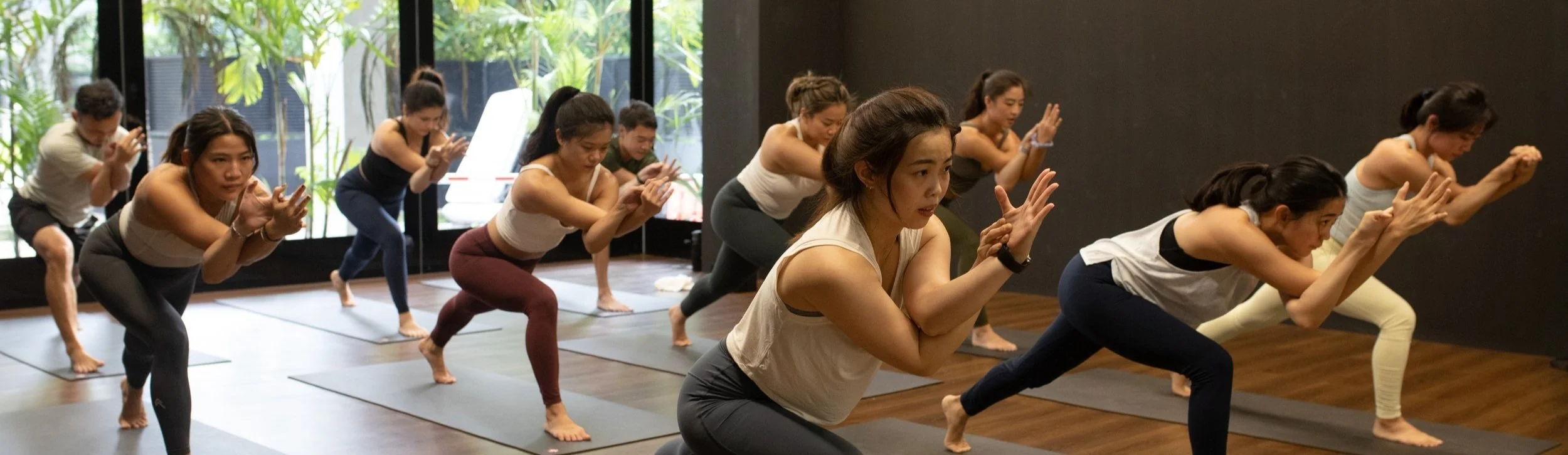
Practice sessions bring these lessons to life. Trainees step onto their mats to explore alignment, transitions, and mindful movement under guided instruction.
The goal isn’t perfection — it’s awareness. These sessions help trainees understand how each pose feels in their own body, allowing them to cue more effectively when teaching others. Getting familiar with the shapes, muscular engagement, and alignment cues of each posture enhances both teaching precision and body intelligence.
It’s also worth remembering that participation doesn’t always mean keeping up with every pose. Simply being present — even observing or taking notes from the sidelines — can be just as beneficial. Watching how poses are demonstrated and taught deepens understanding of alignment, pacing, and cueing.
Practice is where consistency develops — physically, mentally, and emotionally. As trainees progress, they begin to recognise how sequencing, breath, and pacing come together to create a cohesive, purposeful class.
3. Teaching Labs and Peer Learning
A key part of YTT is peer teaching — practising how to communicate instructions, observe alignment, and hold space for others.
Trainees often teach short sections of a sequence to one another, exchange feedback, and discuss what worked and what could be refined. This process encourages collaboration and helps build confidence in using their voices as future teachers.
Every session becomes a shared learning experience — an opportunity to see different approaches, refine cueing language, and discover how personal teaching styles start to emerge.
By the end of training, most programs culminate in a final teaching assessment — a full-length class led independently by each trainee. It’s both a test and a milestone that reflects how far they’ve come in understanding and communication.
4. Personal Growth and Reflection
Beyond the physical and technical aspects, yoga teacher training encourages personal growth and self-awareness. Through journaling, discussions, and group reflections, trainees explore what it means to teach with authenticity and empathy — skills that extend far beyond the mat.
Learning to guide others begins with understanding your own patterns and presence. The more self-aware a teacher becomes, the more confidently they can create space for others to learn and grow.
5. Life Beyond the Mat
While YTTs are often remembered for their physical and mental challenges, they’re equally about the community and shared experience built along the way. Many trainees find encouragement, accountability, and inspiration from peers who are on the same journey — learning, growing, and supporting each other through every stage.
To see what a day within this environment looks like, you can watch our short video: A Day in the Life of a Freedom Yoga YTT Trainee.
Want to Learn More?
If you’re curious about what a day at Freedom Yoga’s YTT might look like, you can:
Explore our 200-hour Yoga Teacher Training page for curriculum details and downloadable brochures.
Visit our FAQ section to ask questions like “What’s a typical day at YTT like?”
Join an Asana Immersion class to experience part of the training environment firsthand.